

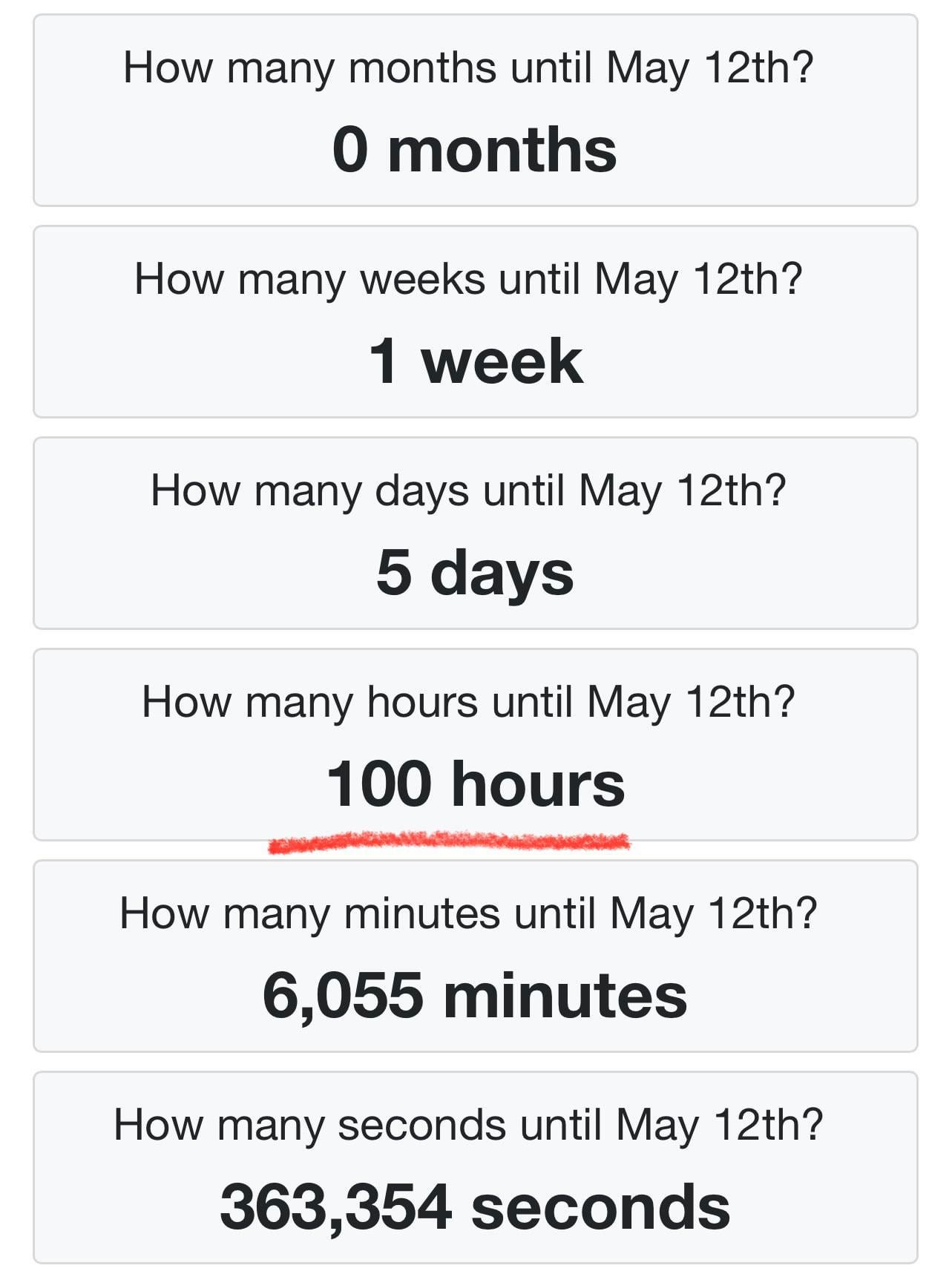
100 hours is equivalent to 4 days and 4 hours. Understanding how many days is 100 hours can come in handy when planning your time effectively. Breaking it down into days and hours provides a clearer perspective on the duration. Let’s delve deeper into this conversion to grasp the concept fully. Keep reading to uncover the simplicity behind translating hours into days.

How Many Days is 100 Hours?
Introduction
Have you ever wondered how many days are in 100 hours? Time is a fascinating concept. In this article, we’re going to explore just how many days 100 hours translates to and uncover some interesting facts along the way. So, let’s dive in!
Understanding Hours and Days
Before we delve into how many days are in 100 hours, let’s first understand the basics. An hour is a unit of time equal to 60 minutes, and a day comprises 24 hours. So, when we think about how many days 100 hours represent, we need to do a little bit of math.
Calculating the Number of Days
To find out how many days are in 100 hours, we can start by dividing the total number of hours by 24, which is the number of hours in a day. Let’s do the math:
100 hours ÷ 24 hours/day = 4.1667 days
Therefore, 100 hours is equivalent to approximately 4.17 days.
Why Does Knowing This Matter?
You might be wondering why knowing how many days are in 100 hours is important. Well, understanding conversions between different units of time can be helpful in various real-life situations.
Time Management
Knowing how to convert between hours and days can aid in effective time management. For example, if you have a project that requires 100 hours to complete, knowing that it equates to around 4 days can help you plan your schedule better.
Travel Planning
When planning a trip or vacation, understanding time conversions can be useful. If your flight is 100 hours long, you can now easily estimate how many days you’ll be in transit.
Work and School
Students and professionals can benefit from knowing how to convert hours to days. It can help in scheduling study sessions, meeting deadlines, or organizing work shifts effectively.
Interesting Facts About Time
Time is not just a measurement; it’s a fascinating concept that has intrigued humans for centuries. Here are a few interesting facts about time:
Time Zones
Did you know that the world is divided into different time zones to account for the Earth’s rotation? Each time zone is one hour apart, with some exceptions based on countries or regions.
Ancient Timekeeping
Ancient civilizations like the Egyptians and Babylonians used various methods to track time, including sundials, water clocks, and even candle clocks. Timekeeping has come a long way since then!
The Longest Day
On June 21st, the summer solstice, some parts of the world experience the longest day of the year with the most daylight hours. Conversely, the winter solstice on December 21st is the shortest day of the year.
So, there you have it – 100 hours is approximately 4.17 days. Understanding how to convert between hours and days is a valuable skill that can come in handy in various aspects of our lives. Time is a precious resource, and knowing how to manage it effectively can make a big difference. Remember, every hour counts, so make the most of your time!
What Happened When I Didn’t Eat for 100 Hours?!!😳
Frequently Asked Questions
How many days is 100 hours?
100 hours is equivalent to approximately 4 days and 4 hours. To calculate this, you divide the total number of hours by 24 (the number of hours in a day).
Can you explain how to convert 100 hours into days?
To convert 100 hours into days, you divide the total number of hours by 24 since there are 24 hours in a day. In this case, 100 hours divided by 24 equals 4 days with a remainder of 4 hours.
What is the exact fraction of a day in 100 hours?
100 hours is equal to 4 days and 4 hours. In fractional terms, this would be 4 and 4/24 days, which simplifies to 4.1667 days.
Final Thoughts
In conclusion, 100 hours is equivalent to approximately 4 days and 4 hours. Understanding how many days is 100 hours can help in better time management and planning. Remember that time is a valuable resource, so make the most of each hour. Plan your tasks wisely to ensure efficient use of time and achieve your goals effectively.